
Monarch Money review: our household-planning winner
Verdict: Monarch Money scores 4.5/5 and is our best budgeting app for couples and shared households in 2026. Its collaborative plan, goals, and broad device support are excellent. Copilot Money still wins overall because Monarch’s transaction review is slower, its information density is higher, and its standard price demands consistent use.
We tested Monarch with two separate logins from June 16 through July 23, 2026. The account mix included four banks, three cards, one mortgage, two brokerages, and a manual home-value asset. Both testers reviewed transactions, changed goals, and used the mobile and web apps. We logged 31 onboarding screens and 463 transactions, including deliberately awkward refunds, reimbursements, and split purchases.
Pros
- Excellent multi-user household access
- Flexible category and rollover plans
- Useful goals linked to real accounts
- iOS, Android, and web support
Cons
- Dense screens require orientation
- Review flow takes more taps than Copilot
- No permanent free tier
- Standard renewal price is substantial
Where Monarch is genuinely excellent
Monarch treats a household as a first-class unit rather than an individual account with a shared password. Invitations were straightforward, each tester kept a separate login, and both people could see the same accounts, transactions, plan, and goals. This sounds basic until one partner needs to reconnect an institution or explain a category change. Shared context lowers the operational burden.
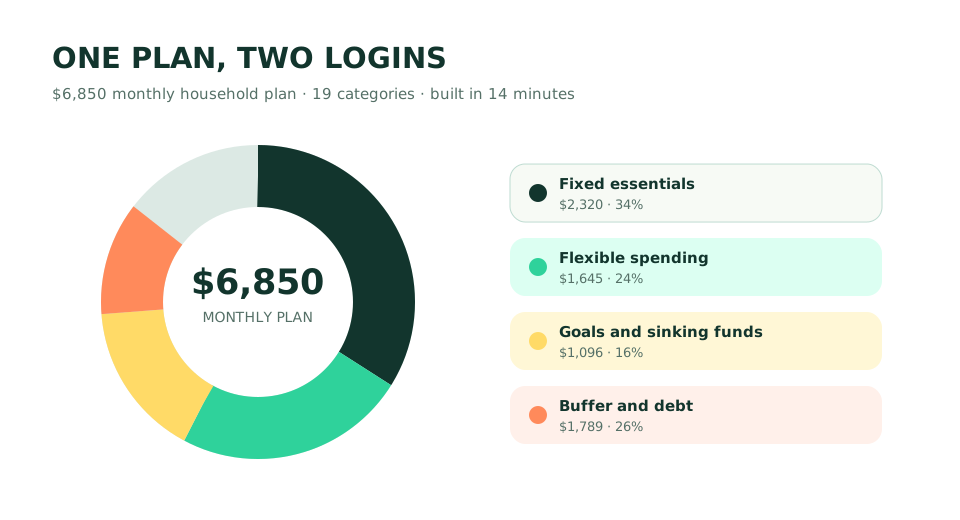
The planning model is flexible without becoming vague. A household can set category targets, group expenses, roll unused money forward, and move between broad flex budgeting and more detailed category limits. We built a $6,850 monthly plan with 19 categories in 14 minutes. Changing the dining target from $420 to $360 clearly updated the remaining plan, with no hidden recalculation.
Goals connect intention to account balances. Our emergency-fund goal used a savings account; a travel goal tracked part of that same account. The interface made the allocation understandable, although users should remember that an app’s label does not physically separate money at the bank. For definitions of goals, rollovers, and sinking funds, see the PurseMint money glossary.
Our weighted Monarch Money score
| Category | Weight | Score | Weighted points |
|---|---|---|---|
| Onboarding | 15% | 4.6 | 0.690 |
| Daily clarity | 25% | 4.3 | 1.075 |
| Automation | 15% | 4.4 | 0.660 |
| Planning tools | 20% | 4.8 | 0.960 |
| Sync reliability | 15% | 4.5 | 0.675 |
| Value | 10% | 4.2 | 0.420 |
| Total | 100% | — | 4.480 → 4.5/5 |
Planning earns 4.8, the highest category score in this test. Daily clarity falls to 4.3 because several screens compete for attention: navigation, account health, plan progress, and transaction status can all feel equally important. The app becomes comfortable after a week, but the first three sessions require more interpretation than Copilot’s guided queue.
The daily workflow is capable, not effortless
Monarch’s transaction list supports search, filters, splits, tags, notes, and rules. That breadth is valuable for complex households. It also creates more controls around the central job of confirming new activity. In a matched test of 20 incoming transactions, our median Monarch review took 2 minutes 14 seconds; Copilot took 1 minute 21 seconds. Both reached the correct result.
Rules performed reliably once configured. Merchant renaming and category rules were easy to inspect, and a rule could apply to existing transactions. Split transactions handled a warehouse purchase cleanly. The unresolved friction was feedback: after some bulk actions, we wanted a more explicit summary of exactly what had changed.
Connection performance depended on the institution. Six accounts remained current throughout. One brokerage delayed positions twice, and one bank required a fresh login after a security update. Monarch offers multiple data providers in some situations, which can help, but switching connections is still work. Our app-selection guide explains why testing your actual bank matters more than any universal sync claim.
Pricing and value in August 2026
As of August 5, 2026, the official Monarch Money site lists standard US pricing at $14.99 per month or $99.99 per year after its trial. The annual equivalent is about $8.33 per month. Temporary first-year promotions may reduce the initial checkout, but our 4.2 value score uses the normal price a continuing subscriber should expect.
One subscription covers the shared household experience, which improves the equation for couples. At $99.99 per year, two active users cost about $4.17 each per month. A solo user who does not need goals, investment context, or detailed rules pays for breadth they may never touch.
Monarch versus Copilot: the practical choice
Choose Monarch when finances are collaborative, Android support is necessary, or a flexible forward plan matters more than a minimal review queue. It is also better for people who want goals, investments, property, and liabilities on one customizable dashboard. This is a positive recommendation, not a consolation prize.
Choose Copilot when one person does most of the money maintenance and speed is the priority. Copilot’s 4.8 score beats Monarch’s 4.5 because daily review happens more often than plan setup. Our full Copilot Money versus Monarch Money test compares seven categories with the same accounts and task script.
Monarch Money FAQ
How much does Monarch Money cost in 2026?
As checked August 5, 2026, standard US pricing is $14.99 per month or $99.99 per year after the trial. The annual plan averages about $8.33 monthly. Introductory discounts appear periodically, but we score value from the normal renewal price rather than a temporary promotion.
Is Monarch Money good for couples?
Yes. Monarch is our strongest pick for couples who want one shared household view with separate sign-ins. Both people can review transactions, follow goals, and discuss changes without sharing a password. Couples should still agree on category rules, because access alone does not create a shared budgeting method.
Is Monarch Money better than Copilot Money?
Monarch is better for household collaboration, goal planning, and Android support. Copilot is better for fast daily review, interface clarity, and transaction-rule feedback. Copilot wins our overall score 4.8 to 4.5, but Monarch is the more sensible choice when two people actively manage the same finances.